Why Agitation Matters in Your Sprayer
Why Agitation Matters in Your Sprayer
By Joyce Allison Tredaway, Ph.D.
Whitetail Institute of North America
Sprayer agitation is one of the most overlooked parts of herbicide application, yet it plays a major role in whether your weed control succeeds or fails. When agitation is inadequate, the chemical mixture inside the tank begins to separate. That separation leads to inconsistent spray concentration, uneven coverage, clogged nozzles, and in some cases crop injury. In short, agitation is not optional. It is essential.
Why Agitation Is So Critical
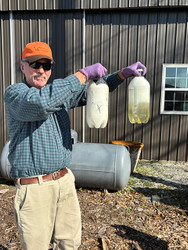
Herbicides come in both dry and liquid formulations, and every one of them must remain fully suspended in the spray solution to work properly. Without agitation, the components begin to settle or separate. In the example shown in the photo, a liquid herbicide and Surefire adjuvant were mixed with water. Within minutes, the herbicide and crop oil separated in the non agitated container, while the agitated mixture remained uniform. That visual difference represents a real difference in field performance.
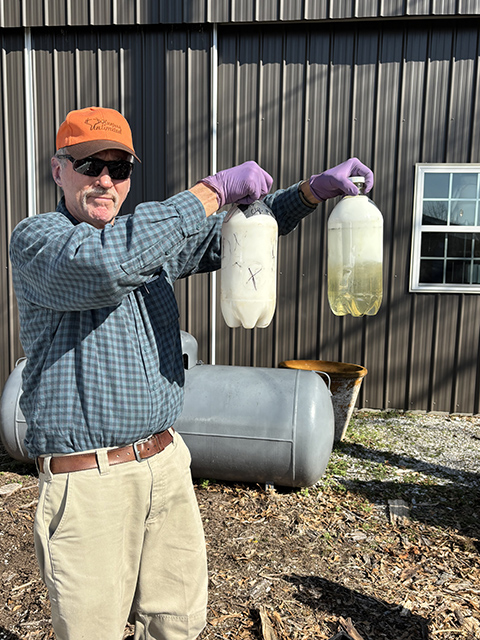
Agitation keeps the spray solution consistent from the first pass to the last. It prevents clogging in nozzles, screens, and lines. Most importantly, it ensures that the concentration of active ingredient remains stable throughout the entire application. When the mixture is uniform, the herbicide can perform the way it was designed to. When it is not, weed control suffers.
How Agitation Works
Sprayers achieve agitation in different ways depending on their design.
Mechanical agitation uses stainless steel paddles or propellers mounted on a shaft inside the tank. The shaft is powered by the engine through belts or pulleys, and the paddles physically stir the solution to keep it mixed.
Hydraulic agitation, often called bypass agitation, is common on tractor sprayers powered by a PTO pump. A portion of the pump’s output is diverted back into the tank through jets or nozzles. This returning flow creates turbulence that circulates and mixes the solution. A typical setup recirculates eight to twelve percent of the total tank volume.
Handheld or pump up sprayers rely on manual shaking to maintain suspension. Because these sprayers have no internal agitation system, the operator must shake the tank frequently to keep the mixture uniform.
ATV sprayers fall somewhere in between. Many do not include built in agitation, so the operator must use a paddle or similar tool to stir the tank before and during application.
The Bottom Line
Agitation is the backbone of accurate herbicide application. It keeps chemicals suspended, protects your equipment from clogs, and ensures that every acre receives the correct concentration of active ingredient. Whether you are using a PTO sprayer, an ATV rig, or a simple hand sprayer, maintaining proper agitation is one of the most important steps you can take to achieve reliable, effective weed control.