The Rest of the Story: Why Patience Matters With Arrest Maxx
The Rest of the Story: Why Patience Matters With Arrest Maxx
By W. Carroll Johnson, III, PhD
Agronomist & Weed Scientist, Whitetail Institute
My colleague Dr. Joyce Tredaway recently shared an excellent overview of Arrest Maxx and how it works. I’d like to follow that up with a true story—one that goes back more than 40 years—to show exactly why patience is essential when using this herbicide.
A Breakthrough in Grass Control
In the early 1980s, while I was in graduate school at North Carolina State University, I worked on a research team evaluating experimental herbicides for grass control in soybean, cotton, and peanut. At that time, selectively controlling emerged grasses in broadleaf crops simply wasn’t possible.
Then came a new chemical family of herbicides—modern marvels that changed agriculture. They were slow, subtle, and incredibly effective.
One of those early experimental products was known only as BAS 9052.
A Summer, a Garden, and a Problem
My late father, Dr. Wiley Johnson, was an agronomist and plant breeder at Auburn University. Years later, as a clover breeder for the newly formed Whitetail Institute, he developed the original versions of Imperial Whitetail Clover.
But long before that, he had something he loved just as much as plant breeding: his vegetable garden.
It was his escape—his stress relief. And in the wet summer of 1982, the grasses got ahead of him. Badly.
Sound familiar to anyone managing food plots?
I was away at graduate school when he called midweek, frustrated and looking for advice. I told him about BAS 9052, the experimental herbicide we were testing. It controlled grasses in broadleaf crops with no injury to the crop itself. I also warned him:
“It’s slow. You won’t see anything for at least a couple of weeks.”
I suggested he ask his weed science colleagues at Auburn if they had any on hand. They did. He sprayed it—nervously.
Two Days Later…
He called again.
“It didn’t work,” he said.
I reassured him that this was normal. Then I walked him through the earliest sign that the herbicide was doing its job:
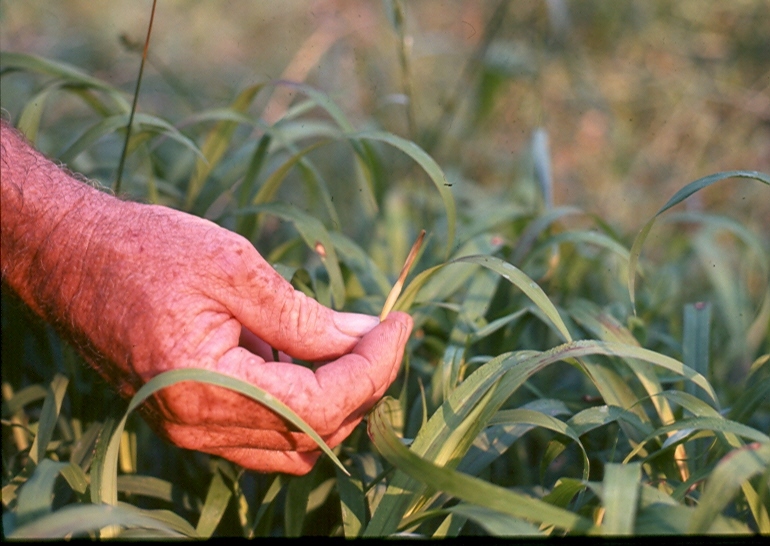
- Pull an unfolded leaf blade from the whorl of a treated grass.
- Look at the base.
- If it’s brown or purplish, the herbicide is working.
He checked. It was. I told him to give it time.
A Few Days After That…
The phone rang again. This time, he didn’t even say hello.
“I like that stuff!”
The grasses were yellowing and dying. His green beans, peas, and cucumbers were untouched. The herbicide had saved his garden.
That experimental product—BAS 9052—eventually became sethoxydim, the active ingredient in the original Arrest. Arrest Maxx, the product we use today, is clethodim, a second‑generation improvement in the same herbicide family.
What This Means for Your Food Plots
Just like in 1982, these herbicides work—but they work slowly. That’s normal. That’s expected. And that’s how you know they’re doing what they’re designed to do.
The earliest symptom of Arrest Maxx:
- Pull an unfolded leaf blade from the whorl of a treated grass.
- Look at the base.
- If it’s brown or purplish, Arrest Maxx is working—even if the plant still looks green.
Over the next two to three weeks, the grass will turn yellow, then purplish brown, and finally die. Broadleaf forages remain unharmed.
As Paul Harvey would say: “And now you know the rest of the story.”